Showing posts with label victorian. Show all posts

Tuesday, July 10, 2012

Reading Dracula


Have you ever read Dracula? Yesterday I sat down in my pajamas and finished off the last few gripping chapters. I'd borrowed a copy from a friend who hates the spines of her books to be broken and I'm a serial book-bender, so I instantly felt relieved that I'd managed to get to the end with minimal damage, especially as the plot was so exciting. I'd never read a book by Irish-born Bram Stoker before (which is a bit of a sin when you work in literature, in Dublin), but last week I was helping out at a local Stoker conference, so it was the perfect chance to read his most famous novel and hear some incredible scholars (and even Stoker's great, great-grandson) speak about him.

When I began reading Dracula the other week, I was surprised at how much I enjoyed it. As I've mentioned before, I scare quite easily and usually stick to reading material that won't give me nightmares, but as I began reading about the strange Count, his supernatural powers, his intimate, psychical attacks, and the race to find and destroy him, I found that this novel actually gave me a real thrill (even though I did get the creeps at some points). While I did find the novel was a little too long in places, making my attention waver, and the representation of women was very one-dimensional and far too sugary, Dracula was definitely a real page-turner and also very thought provoking. I'd be interested to hear if you've read any of Stoker's other novels, and particularly: how did you feel about Dracula if you'd like to share?

Monday, June 25, 2012

The Moonstone


This morning I *finally* finished reading Wilkie Collins's mysterious detective story, The Moonstone (1868). I hadn't read a full length Collins novel before, only 'Mr Wray's Cash-Box' one of his shorter stories, so I was keen to dig into this 473 page book. The story centers around the disappearance of a precious Indian diamond from an English house. In many ways the story reminded me of other Victorian texts I'd read where an oriental threat appears to invade an English landscape; particularly Arthur Conan Doyle's The Sign of Four (1890) and Richard Marsh's The Beetle (1897). It took me longer than I expected to get through The Moonstone, in fact I think I got through Dickens's epic Bleak House in less time, but in many ways this is because Collins invites his reader to play a time-consuming role as detective themselves. The narrative shifts constantly as various plot details are explained by different characters; from household servants who enjoy smoking pipes and reading Robinson Crusoe, to piebald Doctor's addicted to opium, and self-righteously religious cousins. At the same time, while you read over the various narrative accounts you're challenged as a reader to judge the quality of the narrative for yourself; is the narrator trustworthy? how does their particular take on events compare to the same events described by others? how does each individual narrator figure in the narratives of the others? In this way, the novel challenges its readership by subtly asking these complex questions and testing the reader's own skills of detection and observation. I definitely think this would be a novel that would benefit from a second reading. Have you read any Wilkie Collins? What did you think of The Moonstone if you've read it? I'd be interested to hear.


So the years pass, and repeat each other; so the same events revolve in the cycles of time. What will be the next adventures of the Moonstone? Who can tell! 

p.473

p.p.s. reading this story made me dream about wearing moonstones even more!


Tuesday, June 12, 2012

John Ruskin & The King of the Golden River


Did you know that John Ruskin wrote a fairy tale? The other afternoon I read The King of the Golden River or The Black Brothers: A Legend of Stiria, written by Ruskin in 1841 for 12 year old Effie Gray (the lady he later married). The story wasn't published for another 10 years, but when it finally hit the shelves it sold out in three editions. It's a bit of a change from the ghostly tales of Charlotte Riddell I wrote about last week; this time there are no chilling ghosts, but we do encounter the Southwest wind - a little man with curling facial hair and a long hat - a beer tankard that transforms into a magical dwarf King (who you can spot in one of the illustrations above), and a distant river that is rumored to flow with gold. Though I found this fairy tale quite predictable, there was a lot I liked about it. The language generates pictures, and gently guides the reader along with its fable-esque quality. Ruskin stresses the importance of the imagination, and emphasises that wealth is not necessarily synonymous with gold. He is also keen to highlight the protagonist's selflessness and kindness to others, themes we might expect in a good, wholesome fairy tale for Victorian children. I can imagine that children would still be enchanted by Ruskin's little story today, and it was encouraging to read about how this tale stands out for some people as that first special book they fell in love with. Have you read any Ruskin, or any other Victorian fairy tales? I'd be happy to hear.

p.s. a video from a theatrical production of this story (which goes over most of the plot by the way), and  an interesting article about how John Ruskin's voice might help a capitalist society

Tuesday, June 5, 2012

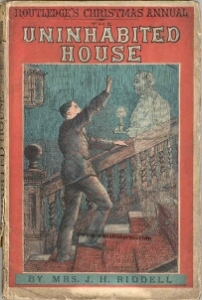
Charlotte Riddell's Uninhabited House


Today I finished reading The Uninhabited House by Charlotte Riddell, a chilling ghost story published in Routledge's Christmas Annual for 1875 (and now widely available in paperback). The characters in Riddell's narrative try to uncover the mystery surrounding a haunted house just outside London, and we quickly find that the story is just as much of a detective/mystery tale as it is a ghost tale. As one young man bravely inhabits the vacant house in an attempt to discover its secret, the novel becomes very suspenseful, and I noticed that I was turning the pages quicker and quicker to find out what would happen. In a Victorian society that venerated domesticity, home and hearth, it is easy to see why The Uninhabited House (from its title alone) would have unnerved contemporary readers; add the threat of a ghost to the plot and I imagine there might have been a few Victorians having sleepless nights. Mrs. Riddell's ghost stories were popular in the nineteenth century, though today few people today have heard of her, or read her works. The formidable image of her above seems to match her preferred genre of writing; the raised black collar reminds me of Dracula (eep!). Do you like reading ghost stories? Would you read them with the lights on, or beside a flickering candle? I'd love to hear. 

Tuesday, May 29, 2012

Moonstones


Do you like gemstones? I think I often prefer them to more expensive stones like diamonds and sapphires (though, FYI, I wouldn't refuse diamonds or sapphires). I've recently discovered my favorite gemstone: the moonstone. I love its muted tones of grey and iridescent white, and bezel set in simple gold the moonstone is understated and stunning. As June draws closer, and with it the Victorian reading challenge, I thought it might be fitting if I put The Moonstone by Wilkie Collins at the top of my reading list, and perhaps once I've finished reading it I might treat myself to a pair of those earrings.

Tuesday, May 8, 2012

Victorian Reading Event


Last night I signed up for A Victorian Celebration. It's a reading event that's going to be hosted by A Literary Odyssey in June & July. I'm feeling motivated to read a few nineteenth-century classics that I've not had the chance to open yet, but what to choose? Do you have any Victorian favourites? I'd recommend Jude the Obscure by Thomas Hardy if you haven't read it yet, it's very gripping and there's a jaw-dropping twist at the end. If you're interested in joining in this reading challenge too you can sign up here, I'd love to hear what you're going to read.